
To add a cost type in Law App, go to File Costs, open the Office Cost or Disbursement cost type list, click Add, fill in the Code, Name, Price and (for disbursements) GL Account, then click Save All. A Cost Type is a re-usable template for an expense your firm records against client files — set it up once, and anyone in the firm can pick it from a dropdown when entering a cost.
The process is the same for office costs and disbursements. The only difference is that a disbursement cost type needs a General Ledger (GL) Account.
No GL Account
A charge the firm records against a client file without drawing from a supplier expense. The default Office Cost GL is applied at billing.
GL Account required
An expense the firm has already paid a supplier for and now wants to recover from the client. The GL Account must match where the original supplier expense was coded.
How to add a cost type
- From the left-hand sidebar, click File Costs, then choose the list for the type of cost you’re setting up:
Office Cost Types for an office cost, or
DIS Cost Types for a disbursement. - Click Add at the top right of the cost type list. A new blank row appears at the top of the table.
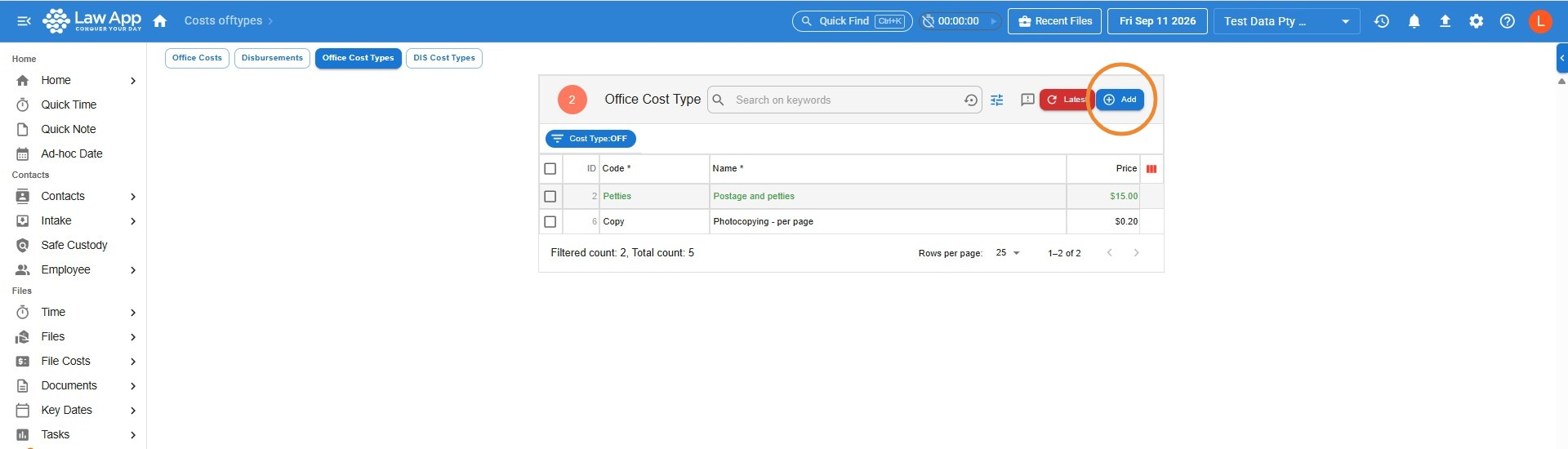
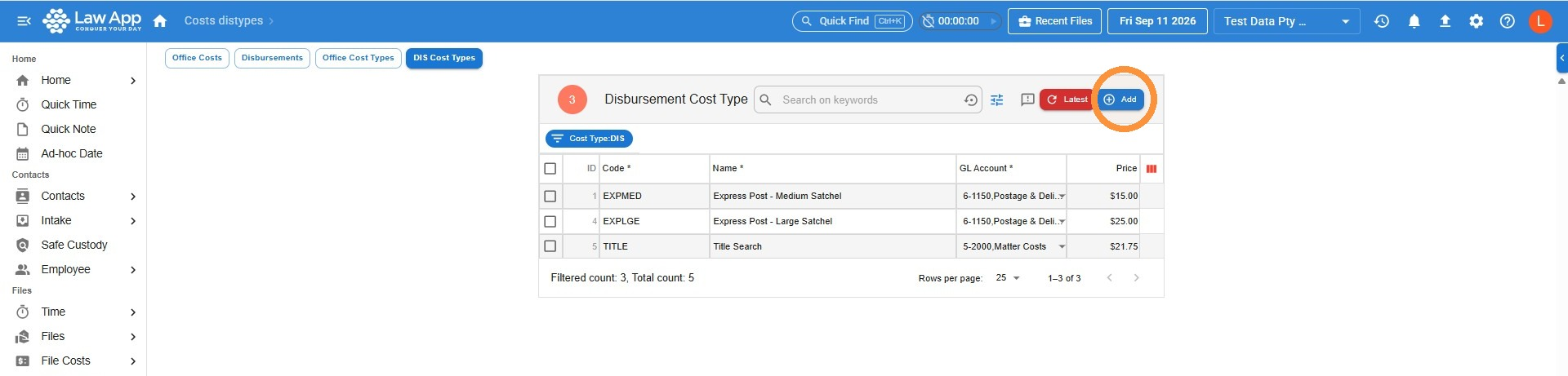
- Fill in the fields in the new row — see what goes in each field below.
- Click Save All at the top of the screen. Your new cost type is now available to select on any office cost or disbursement entry.
What goes in each cost type field
Code
A short, unique identifier that’s easy to recognise in a dropdown. For example, ExpressMED for a medium Express Post bag.
Name
A plain-English description of the cost. This is what appears on bills and reports, so write it the way you’d want a client to read it. For example, Medium Express Post Bag.
General Ledger Account (disbursements only)
Enter a GL Account when you’re setting up a disbursement. It must be the same GL Account the original supplier expense was coded to, because Law App draws the cost from that account when you record the disbursement against a client file.
For example, if your firm bought 10 prepaid Express Post bags and coded them to Postage & Delivery, your ExpressMED cost type must also use Postage & Delivery.
Leave this field blank for an office cost.
Price
The net value of the cost, excluding GST. Law App adds GST at billing. For example, if a medium Express Post bag costs $9.30 including GST, enter 8.45.
Common questions about cost types
Can I edit a cost type after I’ve created it?
Yes. Find it in the cost type list, click into the field you want to change, and click Save All. Transactions already entered with the old values aren’t changed.
What if I set up a cost type with the wrong GL Account?
Edit the cost type and correct the GL Account. New entries will use the corrected account. Past entries keep the GL Account they were posted with — if those need fixing, raise it with your bookkeeper.
Can two cost types have the same code?
No. Each code must be unique within your firm.
Where to next
Your cost type is ready to use. To record an expense against a file:
Entering a cost from the file you’re working in: How to Enter a Cost from Within a File
Leave a Reply